
If you import or private-label baby textiles (pillows, loungers, bedding, feeding supports), compliance is not optional — it is what lets your product clear customs and sit on a retailer’s shelf. This guide maps the common frameworks by market so you can brief your manufacturer accurately.
Baby Textile Certifications for Export: Quick Answer
For B2B buyers: this guide explains the key product specifications, customization choices, compliance questions, sampling process, MOQ considerations and supplier checks needed before placing a private-label order.
- Define first: target market, materials, dimensions, quantity and branding requirements.
- Verify: physical samples, test scope, quality standards, packaging and production timeline.
- Use this guide to: prepare a clearer RFQ and compare manufacturers on equivalent requirements.
Scope note: Baby loungers and support products are not positioned as safe-sleep products. Avoid “anti-SIDS”, “treatment for reflux”, or “guaranteed sleep safety” claims. Compliance documentation should always be verified per applicable brand, model, structure, material and configuration.
United States — CPC / 16 CFR Part 1243 / CPSIA
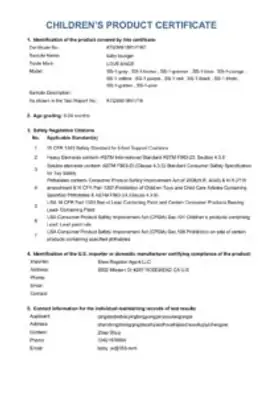
The U.S. expects a Children’s Product Certificate (CPC) backed by third-party testing. For applicable infant support pillow models, documentation under 16 CFR Part 1243 can be provided. Broader children’s-product rules (CPSIA lead/phthalate limits, tracking labels) also apply. We can share applicable compliance and testing documentation for buyer review.
European Union — EN71 / REACH / CE
Toys and child-related items generally reference EN71 (mechanical, flame, migration), REACH (chemical substance restrictions), and where applicable CE marking. OEKO-TEX (per valid certificate, verified for applicable body/product/material/validity) is widely requested by EU buyers as a material-safety signal.
United Kingdom — UKCA / EN71
Post-Brexit, the UKCA mark sits alongside EN71 and UK REACH. Requirements largely mirror the EU framework for now.
Australia / New Zealand — AS/NZS
Expect AS/NZS ISO 8124 (toy safety) and relevant textile/flammability standards. Buyers often request documented material safety testing.
China — GB 31701 / Class A
Domestic and export-from-China textiles follow GB 31701; infant textiles are classified Class A (strictest). We hold China infant-textile Class A test reports.
What Lemaji holds (verifiable, per certificate)
- ISO 9001 quality management system
- SGS material & textile safety reports
- China infant-textile Class A test reports
- Applicable-model compliance documentation (e.g., CPC / 16 CFR Part 1243 for applicable infant support models)
- OEKO-TEX where a current valid certificate applies (verify body, number, material, validity before use)
- BSCI certified manufacturing support
How to use this with your manufacturer
- Name the destination market and sales channel (retail, Amazon, pharmacy, etc.).
- Ask for model-specific test reports — not a generic certificate.
- Confirm the certificate body, number, applicable material, and validity.
- Keep documentation mapped to model / fabric / batch for shipment.
FAQ
Does Lemaji provide CPC for the U.S.?
Compliance and testing documentation is available for applicable models. For applicable infant support pillow models, CPC with 16 CFR Part 1243 documentation can be provided. Always confirm for your specific model and configuration.
Which certificate proves material safety in the EU?
EU buyers commonly ask for EN71 plus REACH, and many request OEKO-TEX (per valid certificate). We hold SGS material/textile safety reports and can share applicable docs.
Is a baby lounger a “safe sleep” product?
No. Baby loungers and support products are not marketed as safe-sleep products, and we do not make anti-SIDS or sleep-safety guarantee claims.
Can you share test reports before I order?
Yes — applicable compliance and testing documentation can be shared for buyer review after we know your market, model and configuration.
Pingback: Baby Gift Set OEM Manufacturer & Buyer’s Guide (2026)
Pingback: Custom Baby Pillow OEM Manufacturer | Private Label Guide