
OEM, ODM, and private label are thrown around constantly in baby-product sourcing — but they are not the same thing, and the model you pick shapes your cost, your speed to market, and how defensible your brand is. This guide explains each in plain language and shows how a 300 pcs trial order lets a new brand start without overstocking.
OEM vs ODM vs Private Label: Quick Answer
For B2B buyers: this guide explains the key product specifications, customization choices, compliance questions, sampling process, MOQ considerations and supplier checks needed before placing a private-label order.
- Define first: target market, materials, dimensions, quantity and branding requirements.
- Verify: physical samples, test scope, quality standards, packaging and production timeline.
- Use this guide to: prepare a clearer RFQ and compare manufacturers on equivalent requirements.
What is OEM (Original Equipment Manufacturer)
In OEM, you bring the design — the shape, materials, dimensions, and specs — and the factory builds it to your drawing. You own the product definition; the manufacturer owns the production. This suits buyers with a clear concept who want full control over how the item is made and branded.
What is ODM (Original Design Manufacturer)
In ODM, the factory provides existing designs that you adapt. You choose from developed shapes and adjust fabric, color, fill, logo, and packaging. It is faster and lower-risk than full OEM because the engineering is already proven — a common path for new brands that want to launch quickly with a differentiated look.
What is Private Label
Private label means selling a manufacturer’s existing product under your own brand, typically with only logo, label, and packaging changes. It is the fastest route to market and the lowest minimum order, but offers the least product differentiation. Many brands start private label, then move toward ODM/OEM as they learn their customer.
OEM vs ODM vs Private Label: the key differences
- Who owns the design: you (OEM) → factory, adapted by you (ODM) → factory (private label).
- Time to market: longest (OEM) → medium (ODM) → shortest (private label).
- Differentiation: highest (OEM) → high (ODM) → low (private label).
- Typical effort: highest engineering input (OEM) → moderate (ODM) → minimal (private label).
Which model should a new baby brand choose?
If you have a unique product idea and the volume to support tooling, OEM gives the strongest moat. If you want to launch fast with a coherent brand, ODM is the pragmatic middle. If you are testing a market, private label is the cheapest first step. Many of our clients start with an ODM or private-label program at 300 pcs, validate sales, then graduate to custom OEM designs. For a product-specific view, see our baby pillow OEM guide and baby lounger OEM guide.
How Lemaji supports all three
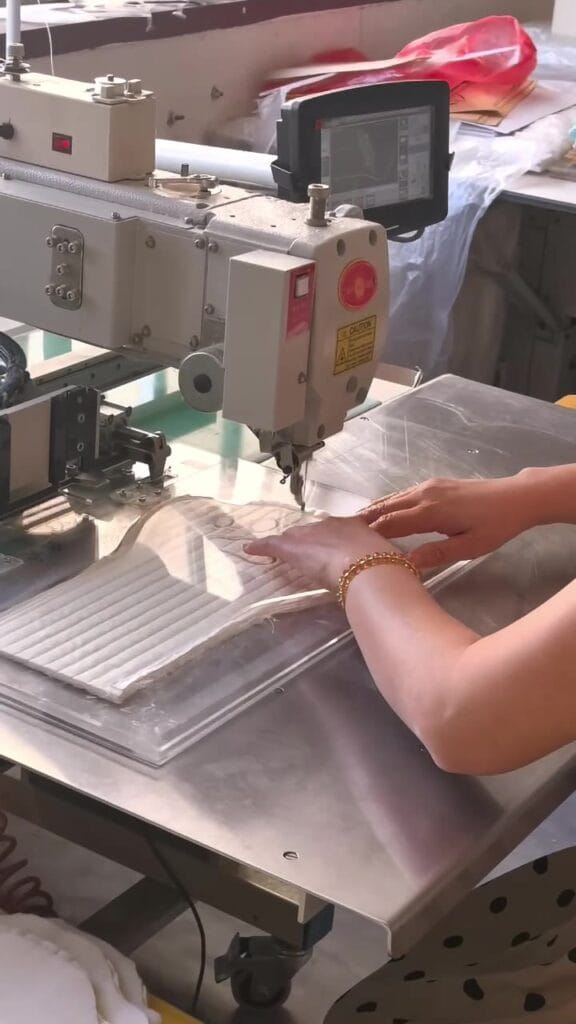
We run OEM, ODM, and private-label programs from one factory with a full in-house chain: cutting → sewing → quilting → embroidery → filling → inspection → packing. A single fabric + color + label + packaging system can span your whole range, so a private-label start and a later OEM line still look like one brand. See our compliance guide for the documentation each model needs by market.
MOQ, sampling, and starting small
- Normal OEM order: 1,000 pcs per design.
- First-time / trial order: minimum 300 pcs per design (specific fabric, packaging and pricing need to be evaluated per product).
- Sampling: ~7 days to a confirmed sample; production starts after sample approval.
- Bulk production: ~30 days after sample confirmation.
- Trade terms: EXW Qingdao / FOB Qingdao.
FAQ
What is the difference between OEM and ODM in simple terms?
OEM means you supply the design and the factory builds it; ODM means the factory supplies a proven design that you adapt with your fabric, color, and branding. ODM is faster to launch; OEM gives more control.
Can a new brand start with a small order?
Yes. Trial orders start at 300 pcs per design, so a new brand can launch 2 designs (about 600 pcs) and expand to ~6 designs within 30 days as sales confirm, without overstocking.
Which model is best for differentiation?
OEM offers the highest differentiation because you define the product. ODM is close behind with adapted factory designs. Private label is the lowest-differentiation but fastest option.
Do you handle compliance documentation for each model?
Yes. We hold ISO 9001, SGS material/textile safety reports, and China infant-textile Class A test reports, plus BSCI certified manufacturing support, and can share applicable compliance documentation per model and market, including CPC with 16 CFR Part 1243 for applicable infant support pillow models.
How fast can we go from selection to shelf?
From product selection to market can be as fast as ~72 days when sampling, approval, and production run back-to-back. Sampling is ~7 days; bulk production is ~30 days after sample approval.
Choose the right custom development path
Include design ownership, target quantity, materials, dimensions, branding, packaging, sample expectations and destination market in the RFQ so the supplier can recommend an OEM, ODM or private-label workflow.
See a product-specific OEM brief · Reduce sample revisions · Request a custom quotation
Pingback: Baby Gift Set OEM Manufacturer & Buyer’s Guide (2026)