
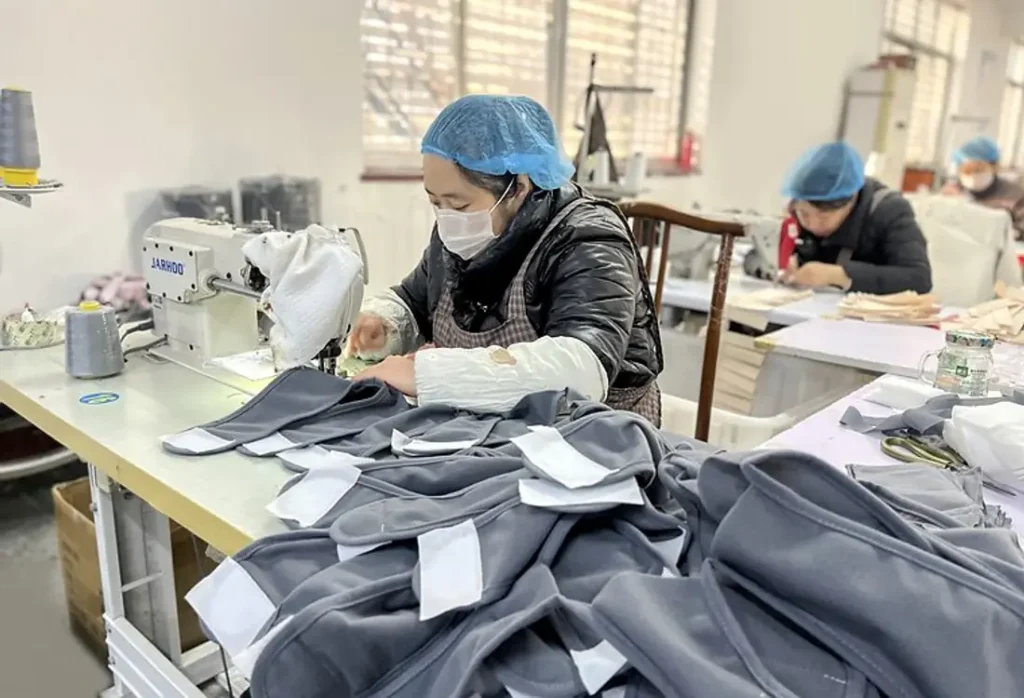
Before you send a deposit, you are really betting on a factory’s ability to deliver safe, consistent product month after month. A factory audit is how you de-risk that bet. This 10-point checklist covers what B2B buyers should verify — certifications, production chain, quality control, and capacity — using Lemaji’s setup as a concrete reference for what “good” looks like.
Baby Textile Factory Audit: Quick Answer
For B2B buyers: this guide explains the key product specifications, customization choices, compliance questions, sampling process, MOQ considerations and supplier checks needed before placing a private-label order.
- Define first: target market, materials, dimensions, quantity and branding requirements.
- Verify: physical samples, test scope, quality standards, packaging and production timeline.
- Use this guide to: prepare a clearer RFQ and compare manufacturers on equivalent requirements.
1. Legal entity and track record
Confirm the supplier is a registered manufacturer with a real operating history, not a trading company passing off as a factory. Lemaji has operated since 2002 — 20+ years in baby and maternity textiles, exporting to 30+ countries and regions.
2. Production chain ownership
Ask whether cutting, sewing, quilting, embroidery, filling, inspection, and packing are done in-house. A full in-house chain means tighter quality control and fewer hand-offs. Lemaji runs the complete chain on site across a 6,000+ m² facility.
3. Certifications and test reports
Request the actual certificates, not a list. Look for ISO 9001 (quality management), SGS material/textile safety reports, and China infant-textile Class A test reports, plus BSCI certified manufacturing support. For the U.S., CPC with 16 CFR Part 1243 applies to applicable infant support pillow models. See our market-by-market compliance guide for what each region expects.
4. Material incoming inspection
Every fabric batch should be tested for composition and weight on arrival. This catches sub-spec material before it enters production — a basic gate that protects your final product.
5. In-process quality control
Quality should be checked during production, not only at the end. Lemaji samples every 200 pcs during production, in addition to incoming and pre-shipment checks — three inspection gates in total.
6. Batch consistency
Ask how tightly repeat orders hold spec. A good factory keeps weight deviation within 5% across five re-orders, so your customers get the same product every time.
7. Capacity and lead time
Verify annual capacity and realistic lead times. Lemaji’s annual output is 5,000,000+ pcs, with ~7-day sampling and ~30-day bulk production after sample approval. Confirm the factory can lock capacity ahead of your peak season.
8. Customization and branding
For OEM/ODM, confirm fabric, color, size, fill, logo, woven label, care label, hangtag, and packaging can all be customized. A single system spanning your range keeps the brand coherent. Our OEM vs ODM vs private label guide explains how to choose the right model.
9. Minimum order and trial terms
Small MOQs let you validate before scaling. Normal OEM is 1,000 pcs per design; trial orders start at 300 pcs per design. A new brand can launch 2 designs, then expand to ~6 within 30 days as sales confirm.
10. Communication and documentation discipline
The factory should map test reports to model / fabric / batch and share applicable compliance documentation for buyer review. Clear documentation at shipment saves you at customs and with retailers.
FAQ
How do I tell a real factory from a trading company?
Ask for the production-chain evidence: in-house cutting, sewing, quilting, embroidery, filling, and packing. A real factory can walk you through each step and show the facility; a trader cannot own that chain.
Which certificates matter most for baby textiles?
ISO 9001 (quality system), SGS material/textile safety reports, and China infant-textile Class A are the core set. Market-specific docs (CPC for the U.S., EN71/UKCA for Europe/UK, AS/NZS for AU/NZ) apply by destination.
What lead time should I expect?
About 7 days to a confirmed sample, then ~30 days for bulk production after approval. From selection to market can be as fast as ~72 days when steps run back-to-back.
Can I start with a small order to test quality?
Yes. Trial orders start at 300 pcs per design, letting you verify quality and fit before committing to a 1,000 pcs per-design production run.
Why does batch consistency matter?
If weight and material drift between re-orders, your customers notice — and returns rise. A factory holding deviation within 5% across five re-orders protects your brand consistency.
Pingback: Baby Play Mat OEM Manufacturer & Buyer’s Guide (2026)
Pingback: Baby Textile Sample Approval Checklist | Lemaji
Pingback: Baby Gift Set OEM Buyer’s Guide | Lemaji